If you’ve ever opened your Bible, read a few verses, and then wondered what you just read, you’re in good company. Everybody starts somewhere. The good news is that you don’t need a seminary degree to study God’s Word. You need a Bible, a little time, and a willing heart. II Timothy 2:15
Study to shew thyself approved unto God, a workman that needeth not to be ashamed, rightly dividing the word of truth. God expects His people to study His Word, and He has made it clear enough for a beginner to start today. Pick a Time, a Place, and a Plan Don’t wait until you “have time,” because you won’t. Choose a time you can keep, even if it’s only ten or fifteen minutes.
Pick a quiet spot, grab a pen and a notebook, and decide ahead of time what you’re going to read.
Having a plan keeps you from wondering where to start each day. (There’s a simple one below.) Start With the Right Bible Before you study, you need a Bible you can trust and will actually use. Walk into a bookstore and you will find dozens of versions, sizes, and styles, and the choices can overwhelm a beginner. Here is some simple guidance. Choose the right translation. God’s Word is not a book of opinions or suggestions. It is a book of pure words, and God has promised to keep them. Psalm 12:6-7
The words of the LORD are pure words: as silver tried in a furnace of earth, purified seven times. Thou shalt keep them, O LORD, thou shalt preserve them from this generation for ever. Matthew 24:35
Heaven and earth shall pass away, but my words shall not pass away. Because God has preserved His words, it matters which Bible is in your hands. At Faith Baptist, we believe the King James Version is the right Bible for English-speaking people. We hold it to be the preserved, trustworthy Word of God in our language, and it is the only translation we preach from, teach from, and put in the hands of our people. It has served believers for over four hundred years, and it has been used of God to bring countless souls to Christ and to build strong churches. We do not say this lightly, and we do not say it out of tradition alone. We say it because we believe God means what He says about His words, and because we want you to build your faith on a text you can be sure of. Stay with one translation. When you read, study, and memorize from the same Bible week after week, the words stay with you, and you can follow along on Sundays without getting lost. Be careful with modern versions and paraphrases. They change, leave out, or reword what God actually said, and a paraphrase often reflects what a writer thinks the verse means rather than what the verse says. Since the whole point of study is to know exactly what God said, begin with the real thing. Choose a Bible you will actually read. The best Bible is one you will open. Consider a few practical things: Readable print. If the type is too small, you will give up quickly. Look at a few sizes before you buy. Room to write. Wide margins or a little blank space let you jot down notes. A cheap notebook works too. Cross-references. A center-column or margin reference system helps you follow a verse to related passages, which we will use in the steps below. A size you can carry. A Bible you can slip in a bag goes places with you. A giant pulpit edition probably stays on a shelf. Durable binding. You will be using this book for years, so a sturdy cover is worth a few extra dollars. You do not need an expensive leather Bible. A simple, inexpensive edition that you will use every day beats a beautiful one that sits unopened. Be careful with study notes. Many Bibles are printed with commentary, charts, and notes on the same page as the Scripture text. Some of these helps are useful, but they were written by men, and they can be wrong. It is easy for a beginner to read a note and treat it as if it were Scripture. If you use a study edition, always read the Bible text first, form your own understanding, and only then look at the notes. Weigh everything by the plain words of the text. II Timothy 3:16
All scripture is given by inspiration of God, and is profitable for doctrine, for reproof, for correction, for instruction in righteousness. Only the Scripture itself carries that promise. Everything else, however helpful, is a tool. Make it your Bible. Mark it up. Write in the margins. Date the verses God uses to speak to you. Years from now, you may treasure that worn, underlined copy more than anything else on your shelf. It is a good thing for a Bible to look used. Psalm 119:105
Thy word is a lamp unto my feet, and a light unto my path. Don’t have one yet? If you do not own a King James Bible, please let us know. We would be glad to put one in your hands. Contact the church office or stop by the welcome table on Sunday. A Simple Bible Study Method: Pray, Read, Ask, Apply There are many methods for studying the Bible, and you will find your own rhythm over time. This one is easy to remember and works with any passage in the book. Think of it as four steps you can repeat every day. Step 1: Pray Bible study is not like studying any other book. The Author is available to help you understand it. That is why prayer comes first. James 1:5
If any of you lack wisdom, let him ask of God, that giveth to all men liberally, and upbraideth not; and it shall be given him. You do not need fancy words. Something like this is plenty: “Lord, help me understand what I read today, show me what You want me to know, and give me a heart that is willing to obey.” The psalmist prayed in a similar way: Psalm 119:34
Give me understanding, and I shall keep thy law; yea, I shall observe it with my whole heart. Notice that he asked for understanding so that he could obey. That is the right motive for studying. We are not collecting information to feel smart. We are learning what God says so we can walk with Him. A few practical thoughts: Pray before you read, not just after. Even thirty seconds sets the tone. Ask God to show you your own heart. The Bible is a mirror as well as a textbook. Pray again when you get stuck. If a verse puzzles you, stop and ask God for light on it. Step 2: Read This sounds obvious, but many of us rush through it. Most confusion clears up when we simply slow down and read carefully. Nehemiah 8:8
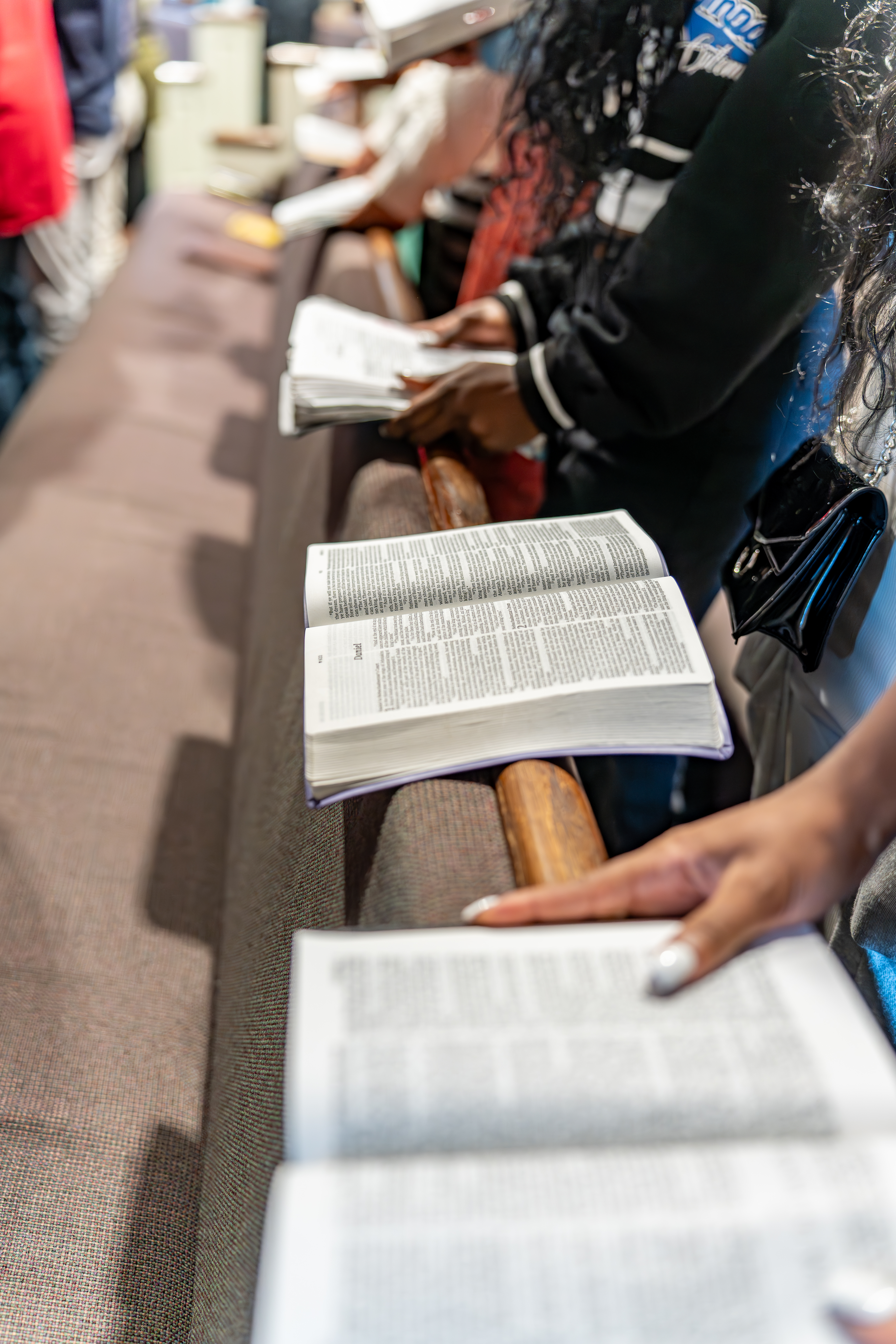
So they read in the book in the law of God distinctly, and gave the sense, and caused them to understand the reading. Here is how to read well: Read the whole passage, not just one verse. A verse pulled out of its setting is easy to misunderstand. Read the paragraph, or even the whole chapter, so you can see what the verse is part of. Read it twice. The first time, just get the flow. The second time, slow down and notice details: repeated words, commands, promises, warnings, and names. Read it aloud if you can. You will catch things your eyes skip over. Mark your Bible or use a notebook. Underline repeated words. Circle commands. Jot down questions in the margin or in your notebook. Start at the beginning of a book and read through it. Jumping around leaves you without context. Reading a book in order, as it was written, helps you follow the author’s thought. If the KJV language is new to you, keep going. You will not catch every word on the first pass, and that is normal. Your ear adjusts faster than you expect. Step 3: Ask Now that you have read the passage, ask it questions. Good questions turn reading into studying. Let me suggest three. Question 1: What does it say? This is observation, which means noticing what is actually on the page before deciding what it means. Ask: Who is speaking, and who is being spoken to? What is happening? Where and when? What words or ideas show up more than once? Are there commands to obey, promises to claim, warnings to heed, or truths to believe? Do not skip this step. Many wrong ideas about the Bible start when people jump to a conclusion before they have carefully looked at the text. Question 2: What does it mean? This is interpretation. You are working out what the passage meant to the people who first received it, because that is what it still means. A few guidelines will keep you on the right track: Let the context speak. Read the verses just before and just after. What is the writer talking about? Take it at its plain meaning. Most of the Bible is meant to be understood the way it reads. Do not hunt for hidden meanings. Let Scripture explain Scripture. Use the cross-references in your Bible. If one verse is unclear, a clearer passage on the same subject will usually help. Check the old words. The KJV sometimes uses words that have shifted in meaning. A Bible dictionary or a concordance like Strong’s can help with a word you do not know. Do not build a teaching on a single verse. If a doctrine is true, it will be supported across the Bible. Ask a mature believer. If you are stuck, bring your question to your pastor or Sunday school teacher. That is what they are for. Question 3: What does it teach me about God, about Jesus, and about myself? Every passage tells us something about who God is. And all of Scripture points to the Lord Jesus Christ. John 5:39
Search the scriptures; for in them ye think ye have eternal life: and they are they which testify of me. So ask: What does this show me about God’s character? Where do I see Christ here, either directly or pointing ahead to Him? What does this reveal about my own heart, my need, or my sin? These questions keep your study centered on the Lord, not just on facts. Step 4: Apply This step is where Bible study turns into Christian living, and it is where many of us stop too soon. Knowing what the Bible says is not the finish line. James 1:22–24
But be ye doers of the word, and not hearers only, deceiving your own selves. For if any be a hearer of the word, and not a doer, he is like unto a man beholding his natural face in a glass: For he beholdeth himself, and goeth his way, and straightway forgetteth what manner of man he was. The Lord Jesus said the same thing at the close of the Sermon on the Mount: Matthew 7:24
Therefore whosoever heareth these sayings of mine, and doeth them, I will liken him unto a wise man, which built his house upon a rock. To make your application specific, try finishing one of these sentences in your notebook: Believe: Today I need to trust that God is _____________. Obey: Today I will _____________ because the Bible says to. Confess or change: God showed me that I need to turn from ___________________. Pray: Because of what I read, I will pray for _____________. Share: I will tell _____________ what I learned. Pick one and keep it small. One specific step you actually take is better than a long list of good intentions. Then, before you close your Bible, thank God for what He showed you. A Quick Example: Philippians 4:6–7 Here is how the four steps might look on a short passage. Philippians 4:6–7
Be careful for nothing; but in every thing by prayer and supplication with thanksgiving let your requests be made known unto God. And the peace of God, which passeth all understanding, shall keep your hearts and minds through Christ Jesus. Pray: “Lord, teach me what You want me to know about worry and peace.” Read: Read the whole of Philippians 4 and notice that Paul is writing from a difficult place, yet he is full of joy. Ask:
What does it say? There is a command (do not be careful), a way to handle it (prayer with thanksgiving), and a promise (God’s peace will guard the heart).
What does it mean? In the KJV, “careful” means anxious or full of care. Paul is saying not to be anxious about anything, and to bring everything to God instead.
What does it teach? God invites us to bring every concern to Him, and His peace is a gift that works even when we cannot explain it. The peace comes “through Christ Jesus.” Apply: “This week, when I start to worry about ______, I will stop and pray about it right then, and thank God for something specific.” Let Scripture Explain Scripture Many Bibles have cross-references in the margin or center column. Those little notes point you to other verses on the same subject. Isaiah describes how God builds understanding: Isaiah 28:10
For precept must be upon precept, precept upon precept; line upon line, line upon line; here a little, and there a little. When something confuses you, don’t panic. Look up the cross-reference. Most of the time, another passage brings clarity. A Few Helps for Reading the KJV Don't skip over the old words. Words like "thee," "thou," and "ye" are really just singular and plural forms of "you." Once you see that, a lot of verses open up. Keep reading when you don’t understand. You aren’t failing. You’re learning. Ask someone. Your pastor, your Sunday school teacher, or a mature believer would love to help you. Memorize a verse now and then. Even one verse a week adds up. Psalm 119:11
Thy word have I hid in mine heart, that I might not sin against thee. A 30-Day Starter Reading Plan Not sure where to begin? Try this one. It’s short enough to finish and meaty enough to feed you. Days 1–21: The Gospel of John.
Read one chapter a day. John tells us why he wrote it: John 20:31
But these are written, that ye might believe that Jesus is the Christ, the Son of God; and that believing ye might have life through his name. Days 22–25: Philippians.
One chapter a day. It’s a short book about joy and about living for Christ. Days 26–30: A Psalm a day.
Read Psalm 1, 23, 91, 100, and 121. When you finish, keep going. Read another Gospel, then Acts, then Romans. The goal isn’t to finish a program. It’s to know God better. Keep It Going Some days will go better than others, and that’s fine. If you miss a day, pick up the next day. Don’t quit. God’s Word is food for the soul: I Peter 2:2
As newborn babes, desire the sincere milk of the word, that ye may grow thereby. The Bereans are a good example for us. They didn’t just listen, they checked for themselves: Acts 17:11
These were more noble than those in Thessalonica, in that they received the word with all readiness of mind, and searched the scriptures daily, whether those things were so. Start today. Open your Bible to John 1, say a short prayer, and read. God will meet you there.